Bill Denomination Calculator: How Many Bills Do You Need?
Learn how to break a target cash amount into bills and coins, find a low-bill combination, and check that your denomination breakdown adds up exactly.
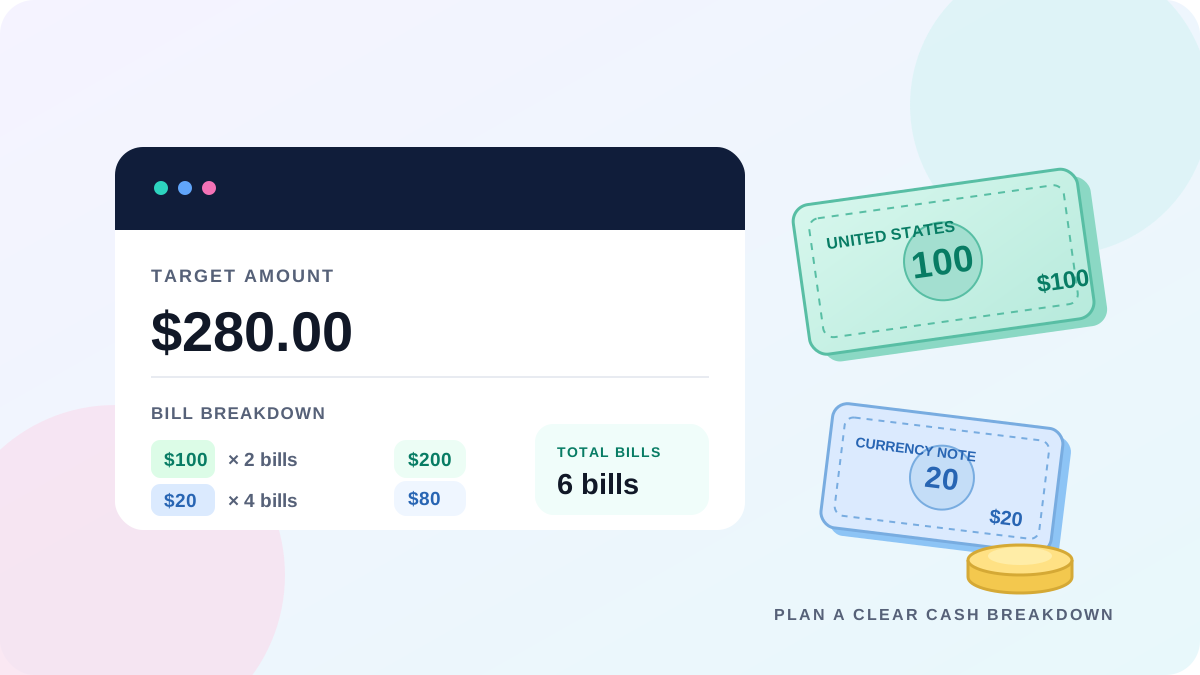
To make an exact cash amount, divide the target by the denominations available to you, starting with the largest useful bill and subtracting its value as you go. A bill denomination calculator can organize the result into a clear currency breakdown. The right combination depends on your currency, available bills, and whether you want fewer bills or smaller change.
For example, $280 can be made with two $100 bills and four $20 bills. For a target with cents, use coins to complete the remaining amount.
How to Break a Target Amount Into Different Bill Denominations
Start with the amount you need and list the denominations available in your currency. A currency denomination calculator can help organize possible combinations. For example, $100 could be one $100 bill, five $20 bills, or several smaller notes. The best combination depends on whether you want fewer bills or more flexible change.
Start With the Largest Available Bill
Starting with the largest useful denomination often reduces the number of bills. For a $280 target, two $100 bills leave $80; four $20 bills complete the amount. This is the basic strategy behind a minimum bills calculator: use large denominations first, then work through the remainder.
Calculate the Remaining Amount After Each Bill
After choosing a denomination, subtract its value from your target. The remainder becomes the next amount to solve. For $175, one $100 bill leaves $75. Three $20 bills leave $15, and three $5 bills finish the calculation. This step-by-step method makes it straightforward to calculate how many bills are needed.
Find the Fewest Bills Needed for a Target
If you want to use the fewest notes, larger denominations usually help. The result still depends on which bills are available. For example, $200 can be made with two $100 bills or ten $20 bills. Both reach the target, but one uses fewer bills. A denomination breakdown calculator can help compare arrangements.
Make an Exact Amount When No Single Bill Matches It
Most targets require a combination of denominations. For $37, one $20 bill leaves $17. One $10 leaves $7, one $5 leaves $2, and two $1 bills complete the amount. Breaking down the remainder this way avoids guesswork and creates an easy-to-check bill breakdown.
Use Coins to Complete an Amount That Bills Cannot
Coins are useful when a target includes cents. For $18.75, you could use $10, $5, $2, and $1 in bills, then 75 cents in coins. Coin denominations fill the final gap when bills alone cannot reach the exact value. Available denominations vary by currency.
Create a Denomination Breakdown for a Cash Withdrawal
Before withdrawing cash, consider how you plan to spend it. A cash denomination calculator can help divide an amount into larger notes and smaller denominations. For example, $300 might be arranged differently for a shopping trip than for an event. Planning the mix can reduce the need to find change later.
Check That Your Combination Adds Up Exactly
Add the value of each bill denomination and coin separately, then compare the total with your original target. This quick check matters because one incorrect note changes the amount. A cash counter can also help verify a cash total.
Find Alternative Combinations for the Same Amount
Many targets have several solutions. A $100 target might use one $100 note, two $50 notes, five $20 notes, or a mix of smaller bills. The most convenient banknote combination depends on what you plan to buy, carry, or distribute.
| Target | Example combination | Number of bills |
|---|---|---|
| $50 | 1 x $50 | 1 |
| $50 | 2 x $20 + 1 x $10 | 3 |
| $100 | 1 x $100 | 1 |
| $100 | 2 x $50 | 2 |