What’s the Easiest Way to Break Large Bills Into Smaller Denominations?
Explore practical ways to break large bills into smaller denominations for shopping, travel, events, petty cash, and business registers.
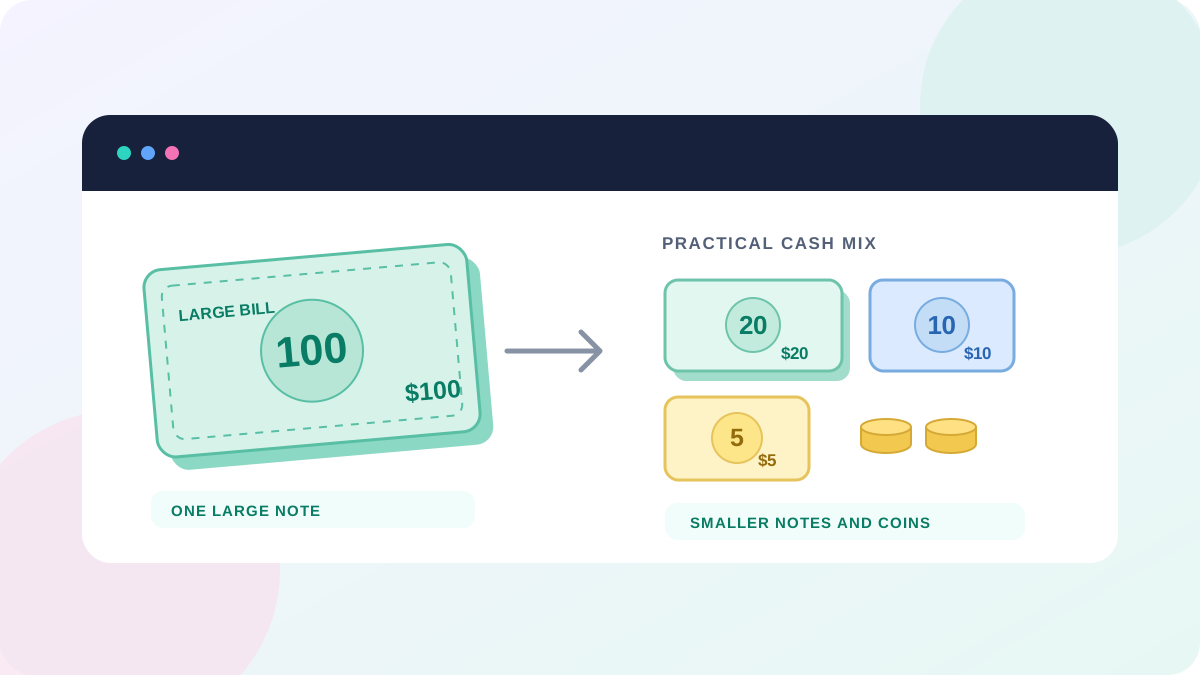
Breaking a large bill into smaller denominations sounds simple until you actually need a useful combination. A single large note may have plenty of value, yet it cannot always handle everyday purchases. A cash breakdown calculator helps transform one amount into several practical bills and coins. This approach works well for shopping, travel, events, petty cash, and business registers. Instead of randomly exchanging money, you can plan a sensible denomination mix that gives you flexibility without filling your wallet with unnecessary change.
How to Convert Large Bills Into a Useful Denomination Mix
The smartest place to begin is with your expected spending. A $100 bill may be convenient for one transaction but awkward for several smaller purchases. Using a denomination splitter, you can divide that amount into useful combinations. For example, $100 could become two $20 bills, four $10 bills, and four $5 bills. The ideal cash distribution depends on how you expect to spend the money.
Why Smaller Bills Can Be More Convenient Than One Large Note
Smaller denominations give you more control at checkout. Imagine having only a $100 bill when your purchase costs $18. You may need to rely on the seller having enough change. A balanced bill mix calculator avoids that problem. Smaller notes can also make budgeting easier because each denomination becomes a practical spending unit. However, too many tiny bills can become cumbersome.
How to Decide Which Denominations You Actually Need
Your spending habits should guide your cash allocation. If you regularly purchase inexpensive items, keep more $1, $5, and $10 bills. If you usually make larger payments, $20 and $50 notes may be more useful. A smaller bills calculator can help compare different combinations before you exchange your money. The goal is not simply to create many bills. The goal is to create useful bills.
How to Break $100, $500, or $1,000 Into Smaller Amounts
Different totals require different strategies. Breaking $100 might require only a handful of notes. Breaking $500 or $1,000 needs more planning because you want enough smaller denominations without creating a huge pile.
For example, $500 could become ten $20 bills, ten $10 bills, and ten $5 bills, with the remaining amount represented by larger notes. A large bill calculator helps you experiment with different arrangements. The best bill breakdown depends on whether the cash supports shopping, business operations, or an event.
How Coins Fit Into a Smaller-Denomination Cash Plan
Coins can complete smaller purchases but should not dominate your cash mix. A loose change calculator can help determine how much coin value you need. For instance, a small event might require quarters and dimes for quick change.
Too many coins create weight and clutter. Therefore, a sensible cash composition balances paper currency with enough coins to handle ordinary transactions.
How to Prepare Cash for Shopping, Travel, or Events
Different situations call for different cash planning. Travel may require several small denominations for transportation, tips, and inexpensive purchases. A community event may need a larger supply of change. Shopping might require mostly $5, $10, and $20 bills.
A travel cash planner can help create a practical mixture before you leave. Planning beforehand means you spend less time searching for change later.
How to Avoid Ending Up With Too Many Low-Value Coins
Small coins are useful, but excessive quantities can become annoying quickly. A coin distribution plan should match realistic spending needs. Instead of carrying dozens of low-value coins, keep a modest reserve and use them when appropriate.
A cash splitter can focus the majority of value on bills while allocating only a reasonable portion to coins. This keeps the overall cash arrangement manageable.
How to Compare Several Denomination Combinations
There is rarely one perfect answer. A $100 amount could be divided into five $20 bills, two $20 bills plus smaller notes, or many low-value denominations.
A denomination mix calculator allows you to compare these arrangements. Consider the number of pieces, usefulness, convenience, and likely spending pattern. Sometimes the mathematically simplest combination is not the most practical one.
| Total | Example Breakdown | Number of Pieces |
|---|---|---|
| $100 | 5 × $20 | 5 |
| $100 | 2 × $20 + 4 × $10 + 4 × $5 | 10 |
| $100 | 10 × $10 | 10 |
| $100 | 20 × $5 | 20 |
How to Plan a Balanced Mix of Large and Small Bills
A balanced cash denomination mix gives you flexibility without unnecessary clutter. Larger notes preserve value in fewer pieces. Smaller notes make everyday transactions easier.
For many situations, combining both types creates the most practical arrangement. A bill selection strategy should therefore consider both immediate purchases and future change requirements.