How to Calculate the Exact Change You Need From Different Bills
Use an exact change calculator approach to combine bills and coins, choose practical denominations, and verify a specific change amount.
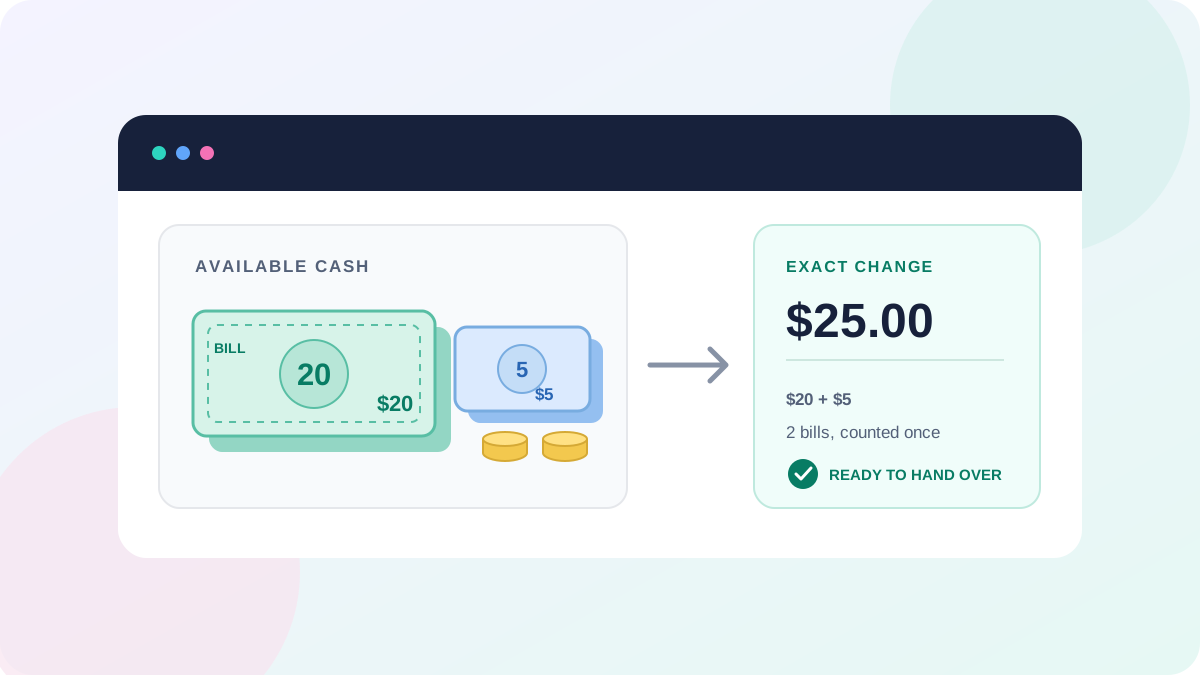
Giving correct change looks simple until several bills and coins are available. The challenge becomes choosing a combination that reaches the exact amount without creating unnecessary clutter. An exact change calculator helps organize that decision. Whether you handle customer payments or prepare a personal cash float, a clear change denomination method keeps the process orderly.
How a Denomination Calculator Can Help Build Exact Change
Start with the amount of change required. Then identify the bills and coins available. A change calculator can show how different denominations combine to reach the target. Instead of grabbing random notes, you create a deliberate cash change breakdown.
How to Combine Bills and Coins for a Specific Change Amount
Suppose the customer needs $37.50 in change. You might use a $20 bill, a $10 bill, a $5 bill, two $1 bills, and two quarters. The total equals $37.50. This bill and coin change method keeps each component visible and easy to verify.
How to Choose Practical Denominations for Everyday Transactions
The mathematically correct combination is not always the most convenient one. A useful change combination should consider what denominations remain in your drawer. Giving away every small bill early can make later transactions harder.
For example, if you have several ways to provide $20, retaining smaller notes may prove more useful. Good cash change planning considers the next transaction rather than only the current one.
How to Avoid Giving Too Many Bills or Coins as Change
Too many pieces create unnecessary handling. If $20 can be given with one bill, there is little reason to use twenty $1 bills. A minimum change calculator can help identify combinations using fewer pieces.
However, convenience should remain balanced with drawer needs. Sometimes keeping a larger bill and using smaller denominations makes more sense.
How to Calculate Change When Several Denominations Are Available
Work from the largest practical denomination toward the smallest. Subtract each chosen value from the required amount. Then use smaller bills or coins to close the remaining gap. This denomination change method resembles solving a small arithmetic puzzle.
For example, $68 could become $50 + $10 + $5 + $2 + $1. The calculation reaches the target without unnecessary pieces.
How to Check Your Change Before Handing It to a Customer
Always verify the amount before completing the transaction. Count the change once while selecting it and again before handing it over. This change verification habit can catch an incorrect note or missing coin.
A quick second check costs very little. Fixing an incorrect transaction later can cost considerably more time.
How to Prepare a Change Fund for a Busy Cash Register
A busy register needs a sensible starting mix. A register change fund should contain enough smaller denominations to handle ordinary transactions without becoming depleted too quickly.
Businesses can create a cash change planner by estimating typical transaction sizes. If customers frequently pay with large bills, more small notes and coins may be useful.
How to Handle Exact Change When Smaller Denominations Are Limited
Sometimes the perfect combination is unavailable. If your drawer lacks enough $1 bills, you may need to use different denominations. A change amount calculator can compare alternatives.
For instance, a $16 change requirement might use a $10, $5, and $1. If no $1 bill remains, another combination may need to use coins or different available notes.
How to Compare Different Ways of Making the Same Change
The same amount can often be produced several ways. Consider $25. You could use one $20 and one $5, five $5 bills, or twenty-five $1 bills. Each reaches the same value, but the practical consequences differ.
| Change | Combination | Pieces |
|---|---|---|
| $25 | $20 + $5 | 2 |
| $25 | 5 × $5 | 5 |
| $25 | 25 × $1 | 25 |
A change combination calculator makes these alternatives easier to compare.